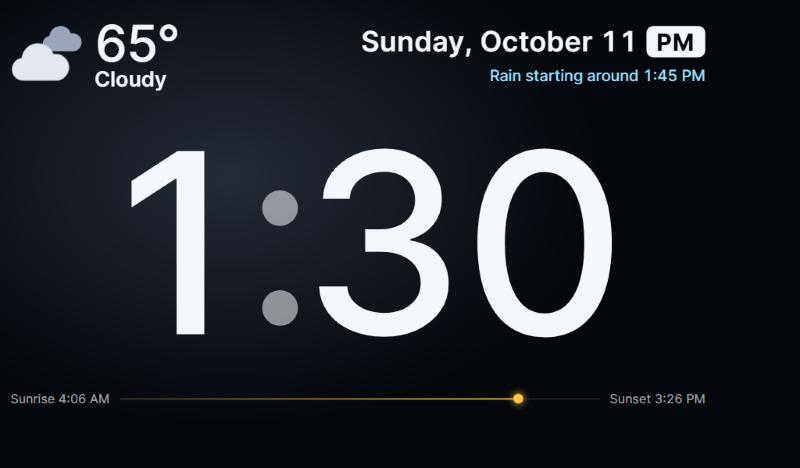
Webclock turns a Raspberry Pi and a 10-inch touchscreen into a clock you can read from across the room, with the weather close at hand. It runs full-screen in a browser in kiosk mode, so there’s nothing to install beyond a web page.
What it shows
- A full-width clock with rolling digits, sized for reading from the other side of the room
- Current conditions: temperature, conditions, the date, and a sunrise-to-sunset bar
- A one-line heads-up pulled from the forecast, such as “Rain starting around 3:20 PM” or “Gusts up to 45 mph around 5 PM”
- The five-day forecast, one tap away. It closes on another tap or after 30 seconds.
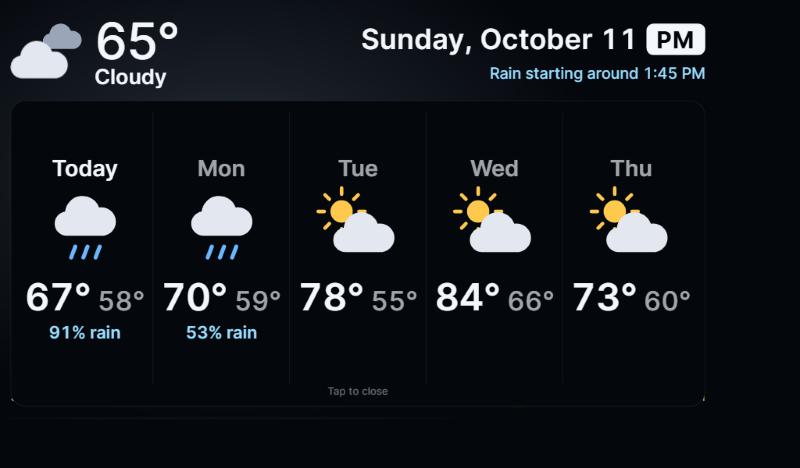 Tap anywhere and the five-day forecast slides in, with the chance of rain where it matters.
Weather alerts that get your attention
Official National Weather Service watches, warnings and advisories appear on the clock and scale with how serious they are: an amber chip for an advisory, an amber glow around the edge for a watch, a red banner for a warning, and a pulsing red banner for something extreme like a tornado warning. Tap an alert for the details. Alerts are checked every three minutes and disappear when they expire. It’s a passive display, not a replacement for emergency alerts on your phone.
Made for living with
A clock runs all day, every day, so the details matter:
- Night mode. Colours turn softer and warmer overnight, and the screen’s backlight is dimmed in hardware on a schedule to match.
- Burn-in protection. The whole layout shifts slowly by a few pixels so nothing stays in one place.
- Graceful when offline. If the network drops, it keeps showing the last good weather with an “updated X minutes ago” note instead of going blank.
How it’s built
Plain HTML, CSS and JavaScript, with no build step and no dependencies. Weather comes from
Open-Meteo and alerts from the
National Weather Service API; neither needs an
API key. Location, units, 12- or 24-hour time, night hours and alert thresholds all live in one settings
file. Updating the clock is a git pull on the Pi.
Some layout ideas came from the open-source round-weather-display project.